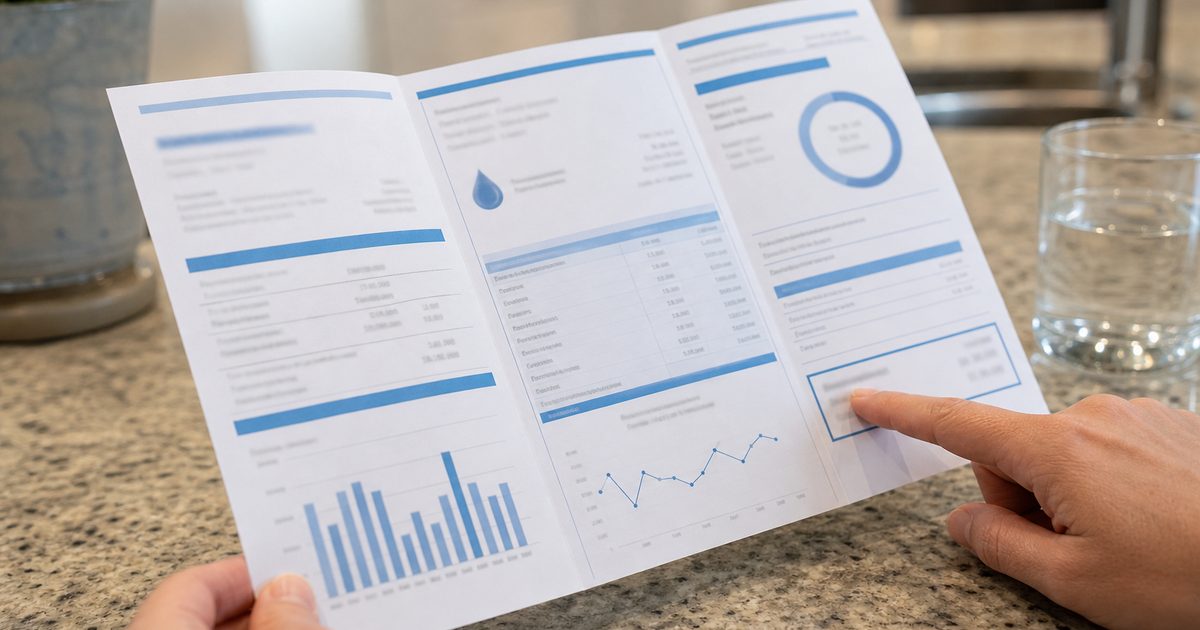
Rural water bills look different from city utilities. Layouts vary by association, but the same pieces show up on almost every invoice: account number, service address, meter readings, usage in gallons, current charges, and amount due. If one line does not make sense, you are not alone. This guide walks through a typical community water bill so you know what you are paying for and when to call the office.
If your association uses Online Water Bill, you can also log into your customer portal anytime to see balance, usage history, and past payments without waiting for the mail.
Quick answer
A rural water bill shows your account number, service address, previous and current meter readings, gallons used, base fee and usage charges, and amount due by the due date. Good systems mail bills in an envelope with a return envelope for checks, not bare postcards that get lost. Check usage history in your association’s customer portal between bills.
Example: Our Sample Water Bill
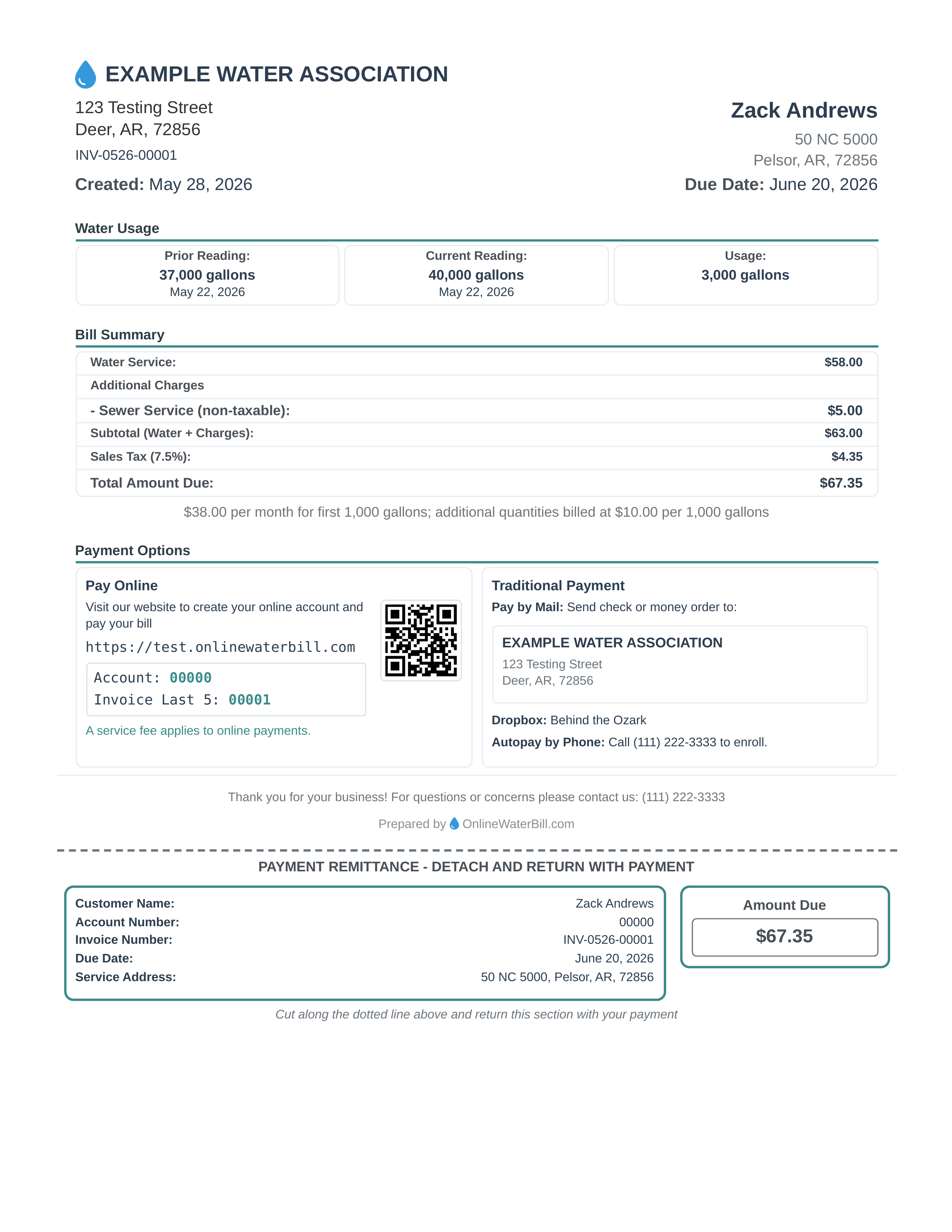
Associations on Online Water Bill mail invoices like the one below: tri-fold layout in an outer envelope (not a bare postcard that can get lost in sorting), association branding, meter readings, itemized charges, a detachable payment stub, and a return envelope for your check. This sample uses fictional data for Example Water Association so you can see real labels without someone’s private account information.
What each section shows
- Header — Association name, Account: 00000, service address, invoice number, bill date, and due date (pay by this date to avoid late fees).
- Water Usage — Prior Reading: 37,000 gallons, Current Reading: 40,000 gallons, and Usage: 3,000 gallons for this billing period.
- Bill Summary — Water Service (base fee plus usage above the included gallons), Additional Charges such as sewer if your board bills them together, Sales Tax when applicable, and Total Amount Due.
- Rate footnotes — Small print under the summary explaining included gallons and per-gallon rates (here: $38 base includes 1,000 gallons, then $10 per 1,000 gallons).
- Pay Online — Portal URL, account number, and QR code to pay from a phone without typing the web address.
- Traditional Payment — Mailing address and dropbox location for checks.
- Remittance stub and return envelope — Tear-off bottom with Amount Due and account number. Good billing systems include a return envelope so your payment is not mailed loose like a postcard that can disappear in transit.
Start at the Top: Who and Where
On the sample bill, the top block lists the association, Account: 00000, and the service address. Every bill should identify three things clearly:
- Account number. Your unique customer ID. Have this ready when you call the office or pay online.
- Service address. The property where water is delivered. This may differ from your mailing address if you get bills at a P.O. box.
- Billing period. The date range this bill covers, usually one month. Usage and charges apply to that window only.
Also note the bill date (when the invoice was generated) and the due date (when payment should arrive to avoid late fees). Rural associations often mail bills and allow two to three weeks before the due date.
Meter Readings and Usage
In the sample Water Usage box, prior reading 37,000 and current reading 40,000 produce 3,000 gallons used. Most water bills show three numbers from your meter:
- Previous reading — the dial or register value from the last billing cycle.
- Current reading — the value read this month (in person, by AMR radio, or estimated if the meter could not be accessed).
- Usage — gallons consumed this period, usually current minus previous.
Usage is the heart of your bill. A summer lawn or a leaking toilet shows up here before it shows up anywhere else. If usage looks wrong, check whether the bill says actual or estimated. Estimated reads can be adjusted on the next actual read, which sometimes makes a single bill look unusually high or low. See our guide on catch-up bills after estimated reads if that happens to you.
Understanding Charges: Base Fee, Usage, and Tiers
On the sample bill, Water Service is $58.00 for 3,000 gallons. The rate footnote explains the math: a $38 base fee includes 1,000 gallons, and usage above that is billed at $10 per 1,000 gallons (2,000 extra gallons = $20, plus $38 base = $58). A Sewer Service line under Additional Charges adds $5 when your association bundles sewer on the same invoice.
Community water associations commonly split charges into:
- Base fee (minimum charge). A flat amount every month that covers fixed costs: mains, tanks, office staff, and debt service. You may see this even when usage is zero.
- Usage charge. Cost per gallon (or per 1,000 gallons) for water you actually used.
- Tiered rates. Some associations charge more per gallon after you pass a threshold, to encourage conservation. Your bill may list Tier 1, Tier 2, and so on with gallons in each band.
Add base fee plus usage (and any tier lines) to get current water charges for this billing period. That is not always the same as amount due, which can include other items below.
Previous Balance, Payments, and Amount Due
The sample bill is a single-cycle invoice with Total Amount Due: $67.35 (water, sewer, and sales tax). Many rural bills also show a running account summary:
- Previous balance — what you owed before this bill.
- Payments received — checks, cash, or online payments credited since the last bill.
- Current charges — water (and sometimes sewer or trash, if your association bills those together).
- Late fees or adjustments — if applicable under your association’s policy.
- Amount due — what you need to pay by the due date.
If you paid last month’s bill in full and usage is normal, amount due should be close to current charges only. A much larger number usually means an unpaid balance, a catch-up from estimated reads, or a one-time fee. Call the office with your account number if the math does not add up.
Taxes, Fees, and Other Line Items
The sample includes Sales Tax (7.5%): $4.35 on taxable charges. Depending on your state and association, you might also see:
- Sales tax on water service (uncommon for some nonprofits, required in others).
- Regulatory or franchise fees passed through on the bill.
- Reconnect or trip charges after a shutoff (policy should be published by the board).
- Donations or capital surcharges if your board voted to fund a specific project.
Each line should have a plain label. If you do not recognize a charge, ask before paying. Associations should document rates and fees in a tariff or rate schedule available to members.
How to Pay Your Bill
The sample bill shows both options side by side: scan the QR code or visit the portal URL to pay online, or detach the stub and mail a check to the address listed under Traditional Payment. Rural water associations typically accept:
- Online through your association’s customer portal (card or bank account).
- Check or money order by mail, often with a return envelope.
- Cash or check at the office or a drop box during business hours.
Your bill should list the mailing address, office hours, portal URL, and phone number. Some associations still mail flat postcard bills with no outer envelope; members and clerks both report those getting lost or damaged in the mail. Good water billing systems send bills in an envelope and include a return envelope for checks. For security tips on online pay, see how water associations accept online payments safely.
Check Usage Online Between Bills
Paper bills arrive once a month. A customer portal lets you log in anytime to see:
- Current balance and due date
- Month-by-month usage history (gallons per billing period)
- Payment history and receipts
- Autopay enrollment, if your association offers it
That history answers most “why did my bill go up?” questions without a phone call. For what a good portal includes, see what a water association customer portal should include.
When to Call the Office
Call your water association (not Online Water Bill support, unless they host your portal) when:
- Usage is zero or unrealistically high and you had no leak or vacancy.
- The bill says estimated and you want to schedule a re-read.
- Amount due does not match payments you already made.
- Your service address or account number looks wrong.
- You need a payment plan or have a dispute under the association’s policy.
Have your account number and a recent meter reading photo handy if you can safely access the meter. That speeds up corrections.
Does your association need clearer bills and a member portal?
Online Water Bill generates itemized invoices and gives members usage history online. Boards see fewer balance calls when people can read their own account.
Frequently Asked Questions
What is the account number on a water bill?
The account number is your unique customer ID with the water association. Use it when paying online, mailing a check, or calling the office so staff can pull up the correct service address and balance.
Why is water usage shown in gallons?
United States water meters are read in gallons (sometimes hundred-gallons or thousand-gallon units on the dial). Your bill subtracts the previous reading from the current reading to show how many gallons you used in the billing period.
What is the difference between a base fee and a usage charge?
The base fee (or minimum charge) is a flat monthly amount that helps cover fixed system costs. The usage charge is variable: you pay for the gallons you actually consume, often at tiered rates.
Why is amount due different from current charges?
Amount due includes your previous balance, payments received since the last bill, current charges, and any late fees or adjustments. Current charges are only for this billing period’s water service.
How can I see my water usage history?
If your association offers a customer portal, log in to view month-by-month gallon usage and past bills. Otherwise, keep your mailed invoices or call the office for a printout.
Why did my bill jump if I did not use more water?
Common causes include estimated reads catching up to actual usage, a hidden leak, a billing period that spans more days than usual, rate changes approved by the board, or an unpaid balance from a prior month. Compare usage gallons, not just dollar amount.
The Bottom Line
A water bill is an account summary: who you are, how much water you used, what it costs under your association’s rates, and what to pay by when. Learn the meter readings and charge breakdown once, and each month’s bill takes a minute instead of a phone call.
Water association boards that want clearer invoices and online usage for members can contact us about Online Water Bill or browse a live example portal.